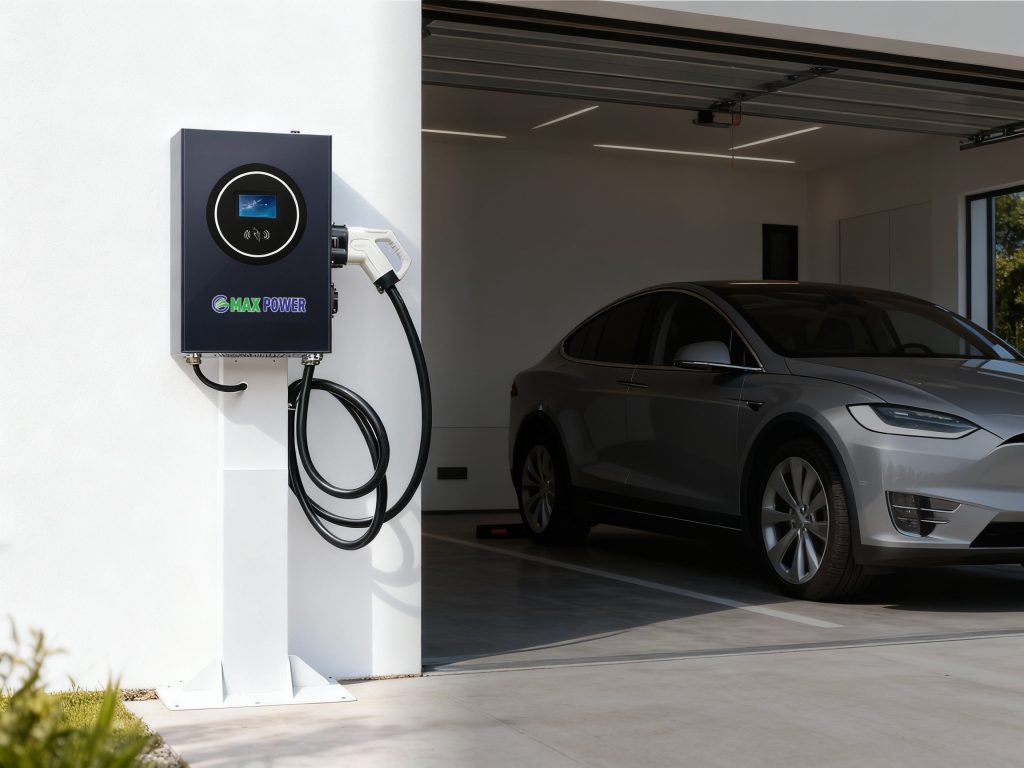
Most commercial EV content talks about DC fast charging. But the bulk of everyday miles — home overnight, workplace daytime, restaurant-and-retail dwell — is still covered by AC Level 2. The decision is not “AC vs DC”; it is “which AC power tier, which safety stack, and which software layer fits the site.”
Max Power’s ACQ Series (single-gun, 7–22kW) and ACP Series (dual-gun, 7–22kW per gun) are built for exactly that split: a home wallbox that behaves like a consumer smart device, and a commercial dual-gun unit that behaves like a revenue node. This guide covers when to use single-gun vs dual-gun, how 7kW serves homes and low-throughput parking, and two deployments — a Brazil residence (ACQ 7kW) and a Russia restaurant carpark (ACP 7kW dual-gun).

Why AC Still Wins for Daily Charging
- Home dwell is long. A 7kW AC unit adds ~7kWh per hour; for 40–60kWh daily home use it covers overnight or part-night charging without a DC cabinet.
- Commercial dwell is variable. Restaurant, office and destination parking often keep cars 1–3 hours — enough for meaningful AC top-up and far cheaper than DC.
- Grid and space constraints. AC avoids large DC connections; wall or column mounting fits garages, small bays and retail lots.
Max Power ACQ is listed as 7–22kW, IP54, TÜV-supported, OCPP 1.6/2.0, wall or column mount. ACP dual-gun is 7–22kW per gun (7+7 / 11+11 / 22+22 configurations), IP54, OCPP 1.6, with floor/column options and multi-standard cables.
Single-Gun ACQ vs Dual-Gun ACP
Parameter | ACQ Series — single-gun | ACP Series — dual-gun |
|---|---|---|
Power per gun | 7 / 11 / 22 kW | 7 / 11 / 22 kW (independent) |
Typical home config | 7kW single-gun | — |
Typical commercial config | 7kW per bay (multiple units) | 7+7kW (14kW total) per site bay pair |
Mounting | Wall / column | Floor / column (wall optional per layout) |
Residential safety | Type-B RCD, SPD optional, DLB | Type-A RCD (+DC sensing per regs), metering |
Home connectivity | Tuya / Bluetooth / app (WiFi/4G optional) | OCPP 1.6J → cloud CMS |
Commercial features | App scheduling, DLB | Independent meters, smart load balancing, remote monitoring, payments, map-APP |
Certifications | IP54; TÜV on ACQ range; OCPP 1.6/2.0 | IP54; OCPP 1.6/2.0 |
💡 Rule of thumb: one household / one car → ACQ 7kW single-gun with DLB and app control. One commercial lot serving two cars or two revenue meters → ACP 7kW dual-gun with OCPP, independent metering and cloud billing.
Home Story: Brazil — ACQ 7kW Single-Gun
A residential user in Brazil wanted reliable home fast-enough charging without overloading the household supply and without industrial-style management software.
Solution: ACQ 7kW single-gun, wall-mounted
- Type-B RCD — detects AC residual current and pulsating DC residual current, the safer domestic default for EV AC/DC leakage scenarios.
- DLB (Dynamic Load Balancing) — reads household load and trims charger output so the main breaker is never exceeded.
- Tuya control board + Bluetooth — owner starts/stops and adjusts current, schedule and limits from a phone app; Bluetooth works even if local Wi‑Fi/cloud is unavailable.
- IP54 wallbox — compact garage/parking-wall install; ACQ range supports 7–22kW in one chassis family.
Result: safe 7kW home charging, phone-controlled, grid-aware. → Full story in [Brazil ACQ Case Study].
Commercial Story: Russia — ACP 7kW Dual-Gun
A restaurant carpark in Russia wanted to convert parking bays into an EV amenity and a secondary revenue line.
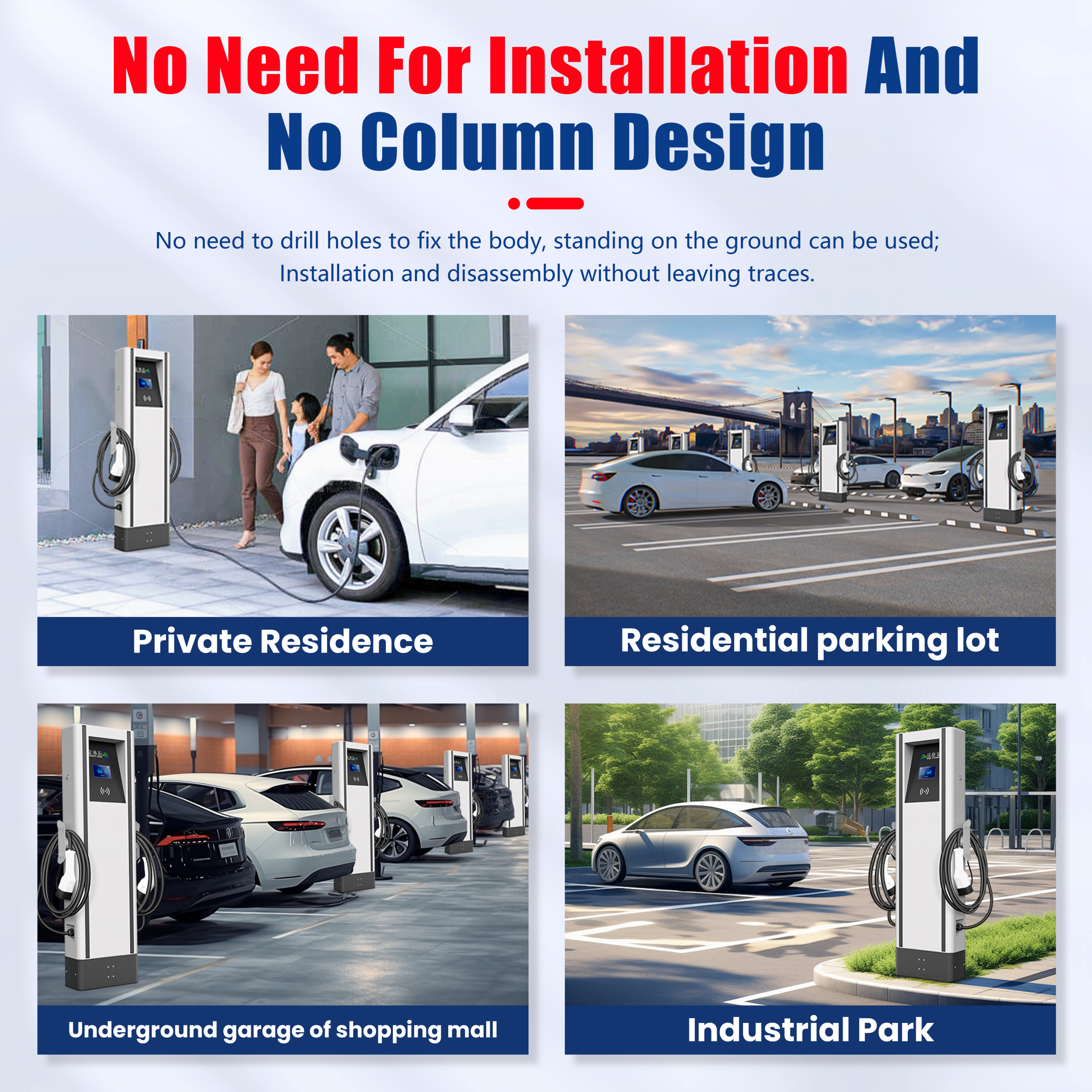
Solution: ACP 7kW dual-gun, column/floor, two independent meters
- 7kW + 7kW per pair — two cars simultaneously, low draw per bay, suitable for dwell-based destination charging.
- Independent energy meters per gun — separate billing, tenant/visitor reconciliation, no shared-meter disputes.
- Type-A RCD (with DC 6mA sensing where local rules require) — commercial AC residual-current protection; configure per Russian/National standards and installer assessment.
- OCPP 1.6J — cloud CMS for status, session data, remote start/stop, fault alerts and tariff control.
- Smart power distribution — OCPP load balancing shares site capacity across multiple ACP units as the bay count grows.
- Payments + map-APP — online payment and third-party map/listing integration turn a parking bay into a discoverable, billable charging point.
Result: restaurant guests charge while dining; operator monitors every gun from the cloud and earns ancillary revenue. → Full story in [Russia ACP Case Study].
Integrating With the Rest of the Network
Both series speak OCPP, so they drop into the same CMS used for Max Power DC/mobile/wall-mounted clusters:
- ACQ homes → Tuya/Bluetooth for owner, optional OCPP upgrade path for property managers.
- ACP commercial → OCPP cloud, same backend logic as Cluster 1 commercial DC and Cluster 5 OC 40kW wall-mount.
➡️ Commercial DC architecture: [Commercial Charging Station Playbook]
➡️ OCPP rules: [OCPP 1.6J vs 2.0.1 Buyer’s Guide]
➡️ Wall-mounted DC home/commercial: [Wall-Mounted DC Charger Guide]
Sizing & Safety Checklist
- Home 7kW: 32A single-phase where local supply allows; Type-B RCD; DLB mandatory on shared mains; SPD if outdoor/surge-prone; app/Bluetooth for usability.
- Commercial 7kW dual: independent meters; Type-A RCD + DC sensing per code; OCPP backend; load balancing per site transformer; payments + map listing for revenue.
- Future-proof: choose OCPP 1.6J now with 2.0-ready firmware; keep connectors matched to local fleet (Type 2 / GB-T / NACS adapters per market).
Conclusion
AC is not “low-end DC.” For homes it is the safe, cheap, app-friendly default; for restaurants, offices and retail it is a dwell-time revenue layer. ACQ 7kW makes home charging personal; ACP 7kW dual-gun makes commercial parking measurable.
Please leave to us and we will be in touch within 24hours.