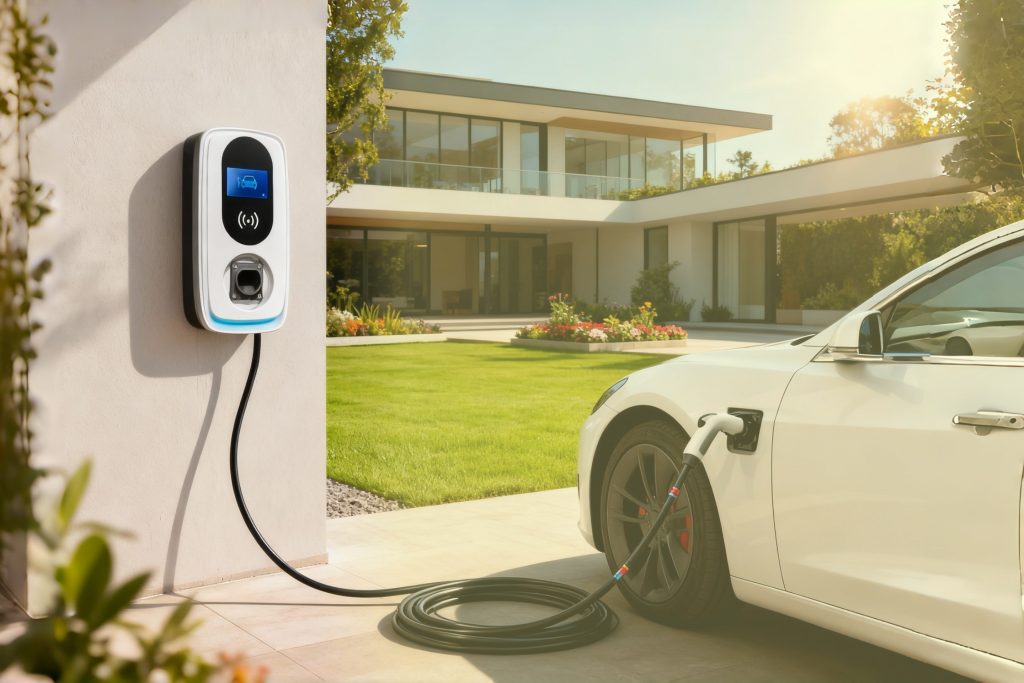
When most people hear “DC fast charger,” they picture a floor-mounted cabinet the size of a refrigerator. But a growing class of chargers—wall-mounted single-gun DC units—is quietly changing where and how DC fast charging gets deployed. Smaller than a traditional DC post, wall-mountable, and available in 20kW (home) and 40kW (commercial) variants, these units bring DC fast charging to places it previously couldn’t reach: a private garage, a small commercial parking bay, a serviced apartment block, or the edge of an industrial park lot.
At Max Power, our SC Series (20kW) and OC Series (40kW) wall-mounted DC single-gun chargers are designed around one principle: match the power, protection, and intelligence to where the charger actually lives. A home charger and a commercial carpark charger may look similar on paper, but the safety stack, connectivity layer, and revenue logic could not be more different.
This guide walks through when to choose wall-mounted DC, how the 20kW and 40kW tiers differ, and two real deployments—one in a Kazakhstan private residence and one in an Ethiopian industrial park carpark.
Why Wall-Mounted DC Is Growing Fast
Three converging trends are pushing wall-mounted DC into the mainstream:
- Homes are getting EVs with bigger batteries. A 7kW AC overnight charge no longer suffices for households with two EVs or a long daily commute; 20kW DC can recover meaningful range during a short dwell.
- Commercial lots are under space pressure. Floor-mounted 120–360kW units dominate high-throughput hubs, but many small-to-mid parking assets simply don’t have the footprint—or the initial throughput—to justify them.
- Smart power management is now table stakes. Whether it’s a homeowner balancing household load (DLB) or a park operator allocating shared grid capacity across bays, the charger must be software-aware.
Wall-mounted DC fills the gap between “slow AC” and “heavy DC,” delivering a practical power tier where space, budget, or grid capacity are constrained.
20kW vs 40kW: Picking the Right Wall-Mounted Tier
Parameter | SC Series — 20kW (Home) | OC Series — 40kW (Commercial) |
|---|---|---|
Typical site | Private garage / villa / apartment block | Commercial carpark / industrial park / fleet bay |
Mounting | Wall-mounted (compact) | Wall-mounted + optional floor pedestal for open lots |
Protection stack | Type-B RCD, SPD (lightning), DLB load balancer | Type-A RCD, OCPP cloud management |
Connectivity | Tuya board — Bluetooth + APP control (start/stop, parameters) | OCPP 1.6J — cloud platform, remote monitoring & smart charging |
Revenue logic | Personal use, no payment terminal | Online payments + map-APP integration for public discovery |
Certifications | IP54; OCPP 1.6/2.0 ready | IP54; TÜV-certified; OCPP 1.6/2.0 |
💡 Rule of thumb: If the user is a person charging their own car, 20kW with Tuya + DLB is the sweet spot. If the user is a parking asset monetizing charging, 40kW with OCPP + payments is the right call.
The Home Story: Kazakhstan — 20kW SC Series
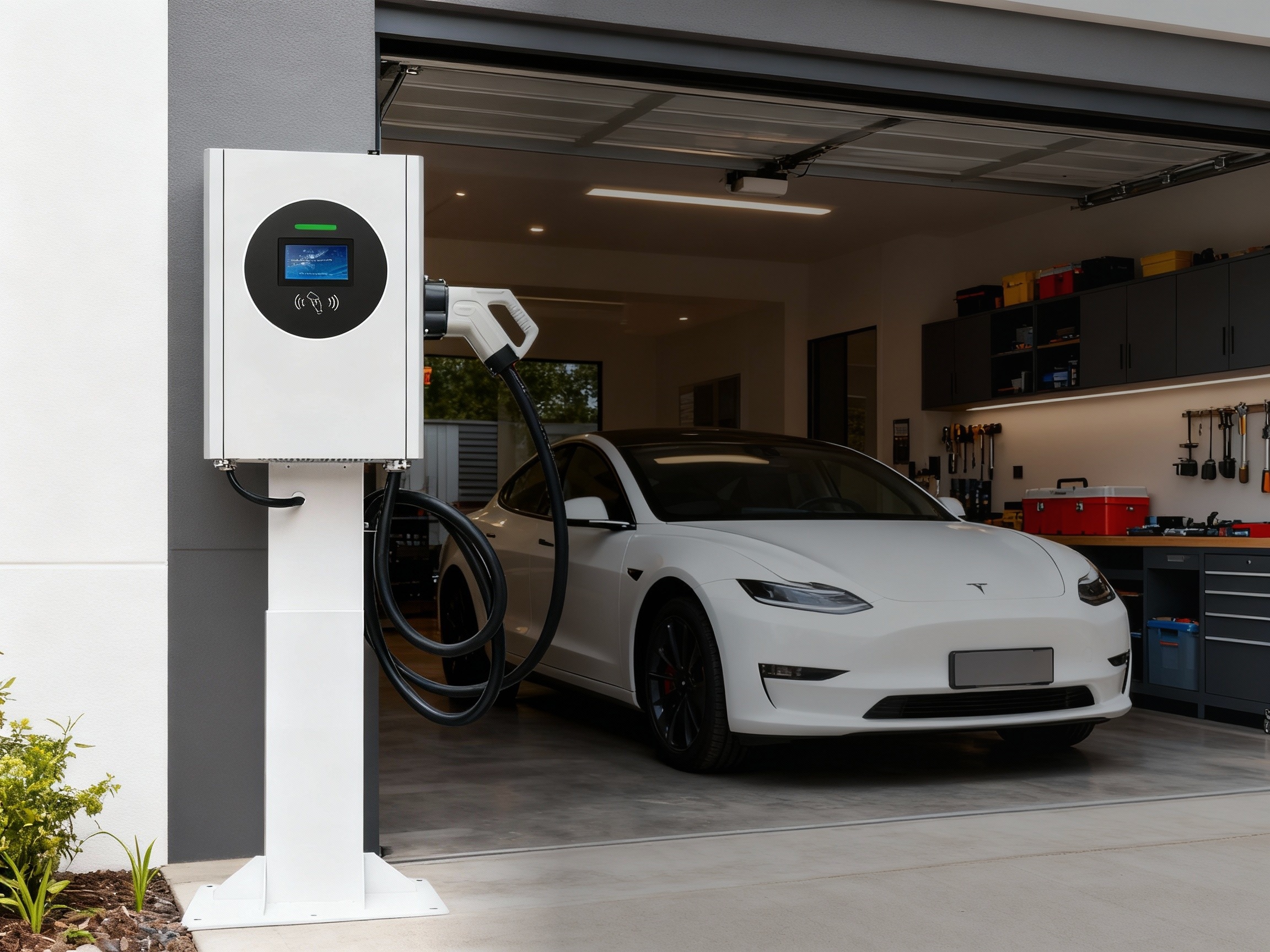
A residential customer in Kazakhstan needed to fast-charge a personal EV at home but had neither the space nor the grid headroom for a floor-mounted DC unit. We deployed a 20kW SC Series wall-mounted DC single-gun charger, engineered for the realities of a private household:
- Type-B RCD (residual current device) — protects against both AC and pulsating DC residual currents, a critical safety requirement for EV DC charging in a domestic environment.
- Surge Protection Device (SPD) — guards against lightning-induced surges, important in regions with seasonal storms.
- DLB (Dynamic Load Balancing) — monitors household consumption and automatically adjusts charger output so the home’s main breaker is never overloaded.
- Tuya control board — lets the owner start/stop charging and adjust parameters through a smartphone APP over Bluetooth, turning the charger into a genuinely user-friendly home device.
The result was DC fast charging in a private garage—safe, grid-aware, and controllable from a phone—without the footprint of a commercial DC post. → Full story in our [Kazakhstan Case Study]
The Commercial Story: Ethiopia — 40kW OC Series
An industrial park carpark in Ethiopia wanted to add EV charging to its parking inventory and generate ancillary revenue from tenants and visitors. The operator chose the 40kW OC Series wall-mounted DC single-gun charger, configured for a public-facing commercial environment:
- 40kW DC output — a meaningful fast-charge tier for a parking bay, balancing charge speed with manageable grid draw.
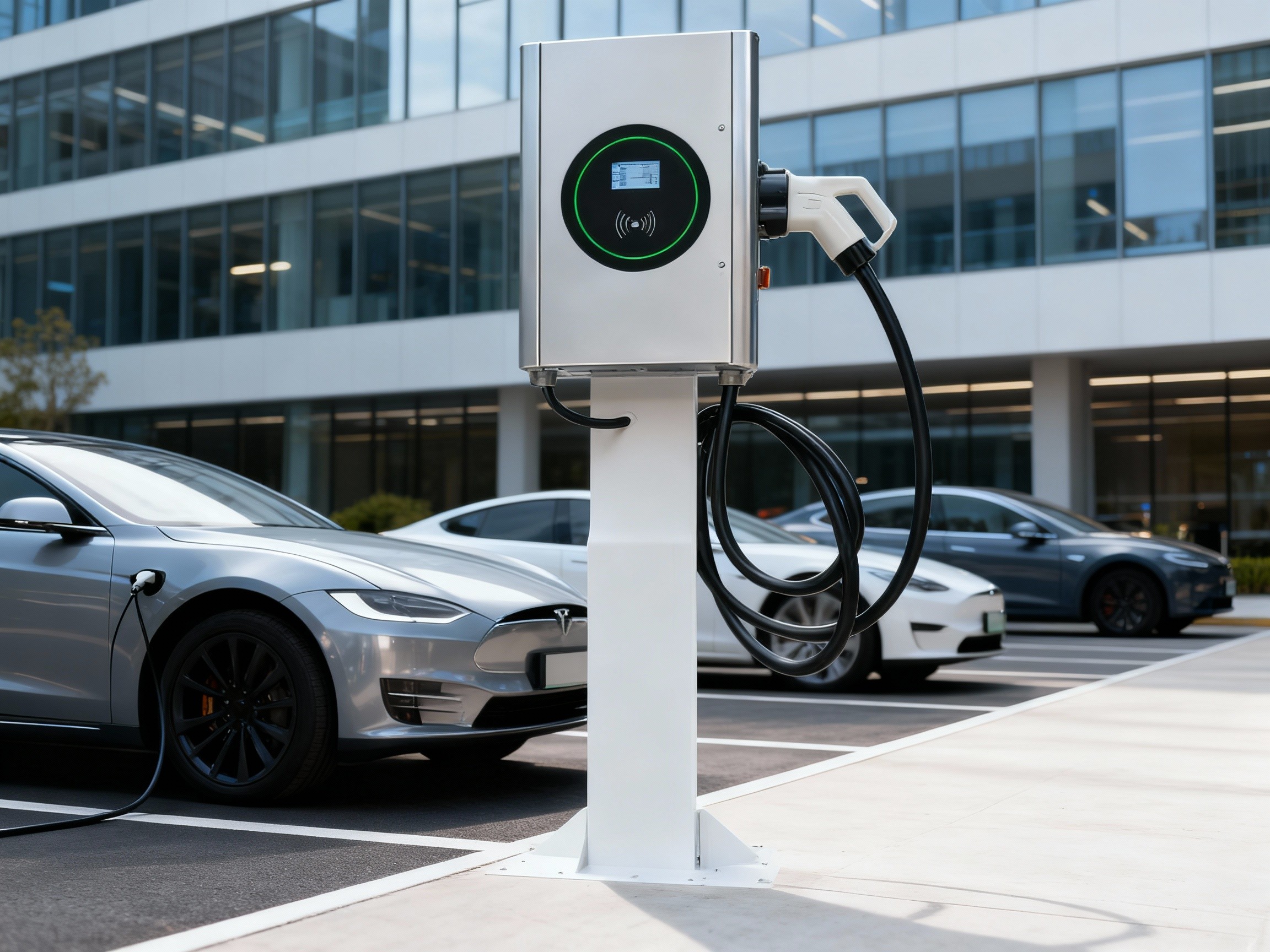
- Floor pedestal / column mounting — while the unit is wall-mountable, the open carpark used a column/pedestal so each bay had its own charger at the vehicle.
- Type-A RCD + OCPP 1.6J — Type-A RCD provides AC residual-current protection suitable for the commercial installation; OCPP unlocks remote management through the operator’s cloud platform.
- Cloud monitoring & smart power distribution — the platform tracks per-gun utilization, electrical parameters (voltage/current/power), and dynamically allocates available capacity across the site’s chargers.
- Online payments + map-APP integration — chargers are discoverable through map applications and support online payment tools, turning a static parking bay into a revenue-generating charging point.
The result was a commercial carpark that went from “parking only” to “parking + charging” in a matter of days, with operators able to monitor and monetize every session remotely. → Full story in our [Ethiopia Case Study]
Integrating With Your Existing Network
Both the SC and OC Series speak OCPP 1.6J (with a 2.0-ready path), so they drop into the same charging management software stack as Max Power’s larger commercial and mobile DC chargers. A homeowner with an SC unit gets Tuya APP convenience; a park operator with multiple OC units gets a unified cloud dashboard. This “scale-up” compatibility is what lets a business start with a few wall-mounted units and grow into a full commercial network without replacing its software layer.
➡️ See how larger networks are architected in our [Commercial Charging Station Playbook]
➡️ Compare protocols in our [OCPP 1.6J vs 2.0.1 Buyer’s Guide]
➡️ Explore mobile DC applications in our [Mobile DC Charging Guide]
Future-Proofing Your Wall-Mounted Investment
When selecting a wall-mounted DC charger, verify these criteria:
- Correct RCD type — Type-B for home DC charging (AC + DC residual currents); Type-A for many commercial installs, per local regulations.
- Surge protection (SPD) — non-negotiable for outdoor or semi-outdoor wall-mounted units exposed to lightning risk.
- Load management — DLB for homes sharing a main breaker; OCPP smart charging for commercial sites sharing a transformer.
- Connectivity fit — Tuya/Bluetooth for personal APP control; OCPP for cloud/OCPP-backend integration and payments.
- Certifications — IP54 as the wall-mount floor; TÜV (where applicable) for commercial credibility.
Conclusion: Right-Sized DC, Right-Placed
Wall-mounted DC charging is not a “smaller” version of a big charger—it is a different product category, optimized for spaces and use cases where floor-mounted DC is overkill. The 20kW SC Series makes DC fast charging safe, smart, and personal for the home. The 40kW OC Series makes it revenue-ready for the commercial carpark.
Whether you’re a homeowner in Almaty or a park operator in Addis Ababa, Max Power’s wall-mounted DC chargers deliver the right power, in the right place, with the right intelligence.
Please leave to us and we will be in touch within 24hours.