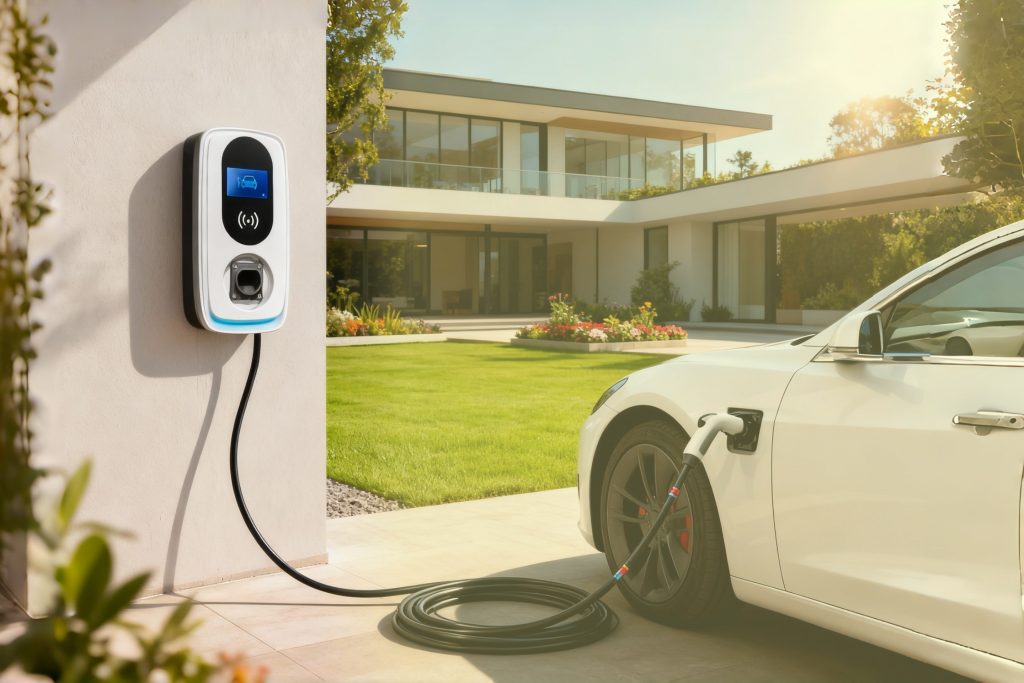
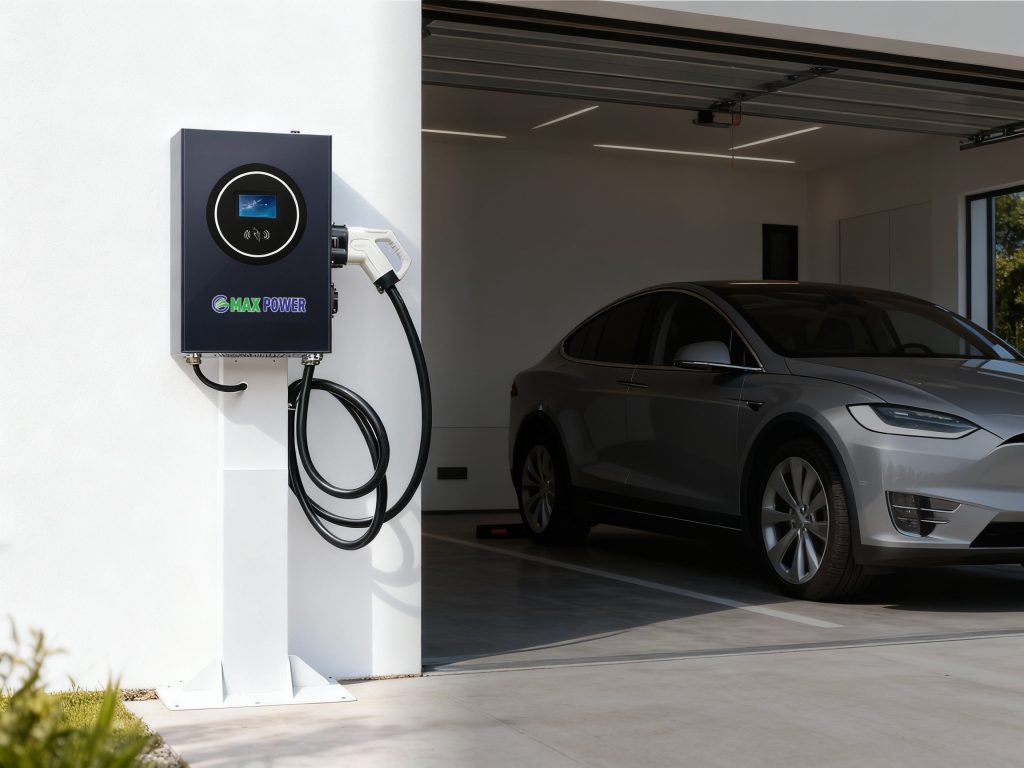
In the era of electric vehicles (EVs), the shift from gas stations to home charging isn’t just a convenience—it’s a revolution. At the heart of this revolution lies the home vehicle charging station: a quiet, reliable companion that turns driveways and garages into personal refueling hubs. For Guangzhou Max Power New Energy Technology Co., Ltd., this revolution is more than a market trend—it’s a mission. Since 2017, Max Power has been crafting ac charging station, home vehicle charging station, and portable ac charging station solutions that blend innovation, durability, and global vision.
Founded in Guangzhou with a 4,000-square-meter production base in Nansha, Max Power was born from a simple belief: green energy should be accessible to all. Its core team, with backgrounds in renowned foreign companies and overseas study, brought decades of new energy expertise to the table, focusing on R&D that marries power conversion technology with user-centric design. Today, with 3 invention patents, 20+ utility model patents, and products exported to 20+ countries—from Germany to the US, Japan to the Middle East—Max Power isn’t just manufacturing chargers; it’s writing a biography of how home vehicle charging station technology evolved to meet the world’s needs. This is the story of that journey.

Max Power: Crafting Home Vehicle Charging Station Legacy
Every great product has a story, and Max Power’s home vehicle charging station legacy began in 2017, when a group of new energy veterans gathered in Guangzhou with a shared vision: “green intelligent manufacturer, for global charging.” They saw a gap in the market: EV owners needed more than just functional chargers—they needed solutions that fit seamlessly into their lives, whether at home, on the road, or in commercial spaces.
Max Power’s 4,000-square-meter factory in Nansha became the canvas for this vision. Divided into R&D labs, production lines, and quality control zones, it’s where ideas turn into reality. The R&D team, with expertise in power conversion, spent months testing prototypes, focusing on safety, efficiency, and user-friendliness. “We didn’t just want to make a charger,” says a senior engineer. “We wanted to make one that feels intuitive—something even a first-time EV owner could set up in minutes.” This focus on usability led to early breakthroughs, like user-friendly interfaces and multi-language support, features that still define Max Power’s home vehicle charging station today.
What sets Max Power apart is its global mindset. With team members who’ve worked abroad, the company designed its home vehicle charging station to meet international standards from day one. Whether it’s adhering to EU safety norms or US electrical codes, every charger undergoes rigorous testing to ensure compatibility with global markets. This foresight paid off: today, their chargers power EVs in Germany’s eco-friendly neighborhoods, Sweden’s cold climates, and India’s bustling cities.
Over the years, Max Power’s product line expanded from fixed home chargers to include wallboxes, portable models, and high-power commercial stations (3kW to 360kW), but the home vehicle charging station remains its cornerstone. “Home charging is where the EV journey starts,” says the CEO. “If we get that right—making it reliable, fast, and easy—we’re not just selling a product; we’re building trust.” That trust is evident in repeat clients, like a European dealership that switched to Max Power after struggling with less reliable chargers: “Their home stations work flawlessly, and their support team is responsive. It’s made our customers’ transition to EVs so much smoother.”

AC Charging Station: Max Power’s Innovation in Every Watt
At the core of Max Power’s offerings is the ac charging station—a technology that balances power and accessibility, making it ideal for homes and small businesses. Unlike high-voltage DC chargers, AC stations are designed to work with standard electrical systems, making them easy to install without major upgrades. For Max Power, perfecting this technology was a labor of love, driven by its R&D team’s expertise in power conversion.
Max Power’s ac charging station stands out for its precision. The team spent years optimizing the power conversion process to minimize energy loss, ensuring that more of the electricity from the grid reaches the EV battery. This efficiency isn’t just good for the planet—it lowers users’ electricity bills. “We tested 50+ circuit designs,” explains an R&D specialist. “The goal was to get as close to 95% efficiency as possible. Today, our AC stations hit 94.8%—that’s industry-leading.”
Safety is another non-negotiable. Every ac charging station includes multiple protections: overcurrent, overvoltage, short-circuit, and ground fault safeguards. They’re also IP55 rated, meaning they resist dust and water jets—critical for outdoor home installations, whether in rainy Guangzhou or snowy Sweden. “A customer in Canada once told us their Max Power charger survived a blizzard with -20°C temperatures,” says a product manager. “That’s the durability we design for.”
The ac charging station also reflects Max Power’s commitment to smart technology. With OCPP1.6J compatibility, it integrates seamlessly with EV management systems, allowing users to monitor charging via apps, schedule sessions during off-peak hours, and track energy usage. For home users, this means convenience: set your charger to start at 2 AM when electricity is cheaper, and wake up to a full battery. For small businesses, it’s a tool to manage multiple chargers efficiently.
Max Power’s ac charging station isn’t just a piece of hardware—it’s a result of 6+ years of refinement. From the first prototype, which took 8 hours to charge a mid-sized EV, to today’s models that deliver 22kW (topping up most EVs in 4–6 hours), it’s a testament to the company’s “rigorous, open, innovative” approach. As one user put it: “My Max Power AC station is so reliable, I forget it’s there—until I need it. And then it never lets me down.”
Home Vehicle Charging Station: The Specs That Define Max Power
Max Power’s home vehicle charging station, ac charging station, and portable ac charging station are more than innovative—they’re engineered to perform. Every spec is a result of user feedback, global standards, and relentless testing. Below is a breakdown of the core features that make Max Power’s chargers stand out:
| Feature | Details |
|---|---|
| Design | Single and dual-port options, suitable for home or small commercial use. |
| Maximum Output | 22kW per port, enabling fast charging (4–6 hours for most EVs). |
| Language Support | Multi-language switching (English, German, French, Chinese, etc.). |
| Weather Resistance | IP55 rating: dust-tight and resistant to low-pressure water jets. |
| Smart Compatibility | OCPP1.6J compliant, integrating with EV management systems. |
| Customization | ODM/OEM services available for tailored designs. |
| Charging Status | Indicator lights (red/error, green/charging, blue/standby). |
| Connectivity | WIFI, Bluetooth, 4G, LAN for app monitoring and control. |
FAQs: Max Power’s Home Vehicle Charging Station Insights
Q1: Home vehicle charging station: Easy to install?
A1: Yes. Max Power’s home vehicle charging station is designed for simple installation. It works with standard 220V/380V household circuits (no major electrical upgrades needed for most homes) and comes with a user manual in 10+ languages. For complex setups, our 24-hour engineering team provides remote support, and we partner with local installers in 80% of export markets. Most users have it up and running in under 2 hours.
Q2: AC charging station: Safe for all EVs?
A2: Absolutely. Our ac charging station is compatible with 99% of EV models (Tesla, BYD, Volkswagen, etc.) thanks to universal connectors (Type 2, CCS, etc.). It includes 7 layers of protection (overcurrent, overvoltage, etc.) and is certified by CE, TUV, UL, and CCC—meeting global safety standards. We also test each charger with 50+ EV models before shipping to ensure compatibility.
Q3: Portable ac charging station: How portable?
A3: Very. Max Power’s portable ac charging station weighs 5–8kg (depending on power) and comes with a carry handle, fitting easily in car trunks or storage. Its 5m cable adds flexibility, and the compact design (30cm x 20cm x 15cm) takes up minimal space. Despite its size, it delivers up to 22kW—perfect for road trips, camping, or emergencies.
Q4: Max Power: Customize portable AC charging stations and home vehicle charging station?
A4: Yes. We offer ODM/OEM services for all products, including home vehicle charging station. Custom options: logos, colors, cable lengths, power outputs (3kW–360kW), and special features (e.g., solar integration). Our R&D team works with you to finalize designs, with prototypes ready in 2–4 weeks. Many commercial clients use this for branding or specific project needs.
Q5: AC charging stations: Global after-sales support?
A5: Yes. We provide 2-year warranties for all stations, with after-sales teams in key markets (Germany, US, Japan, etc.). Our 24-hour technical support (phone, email, video call) resolves 90% of issues in 1 hour. For on-site repairs, we partner with local service providers in 30+ countries. Clients in Europe and North America praise our “fast, reliable support.”